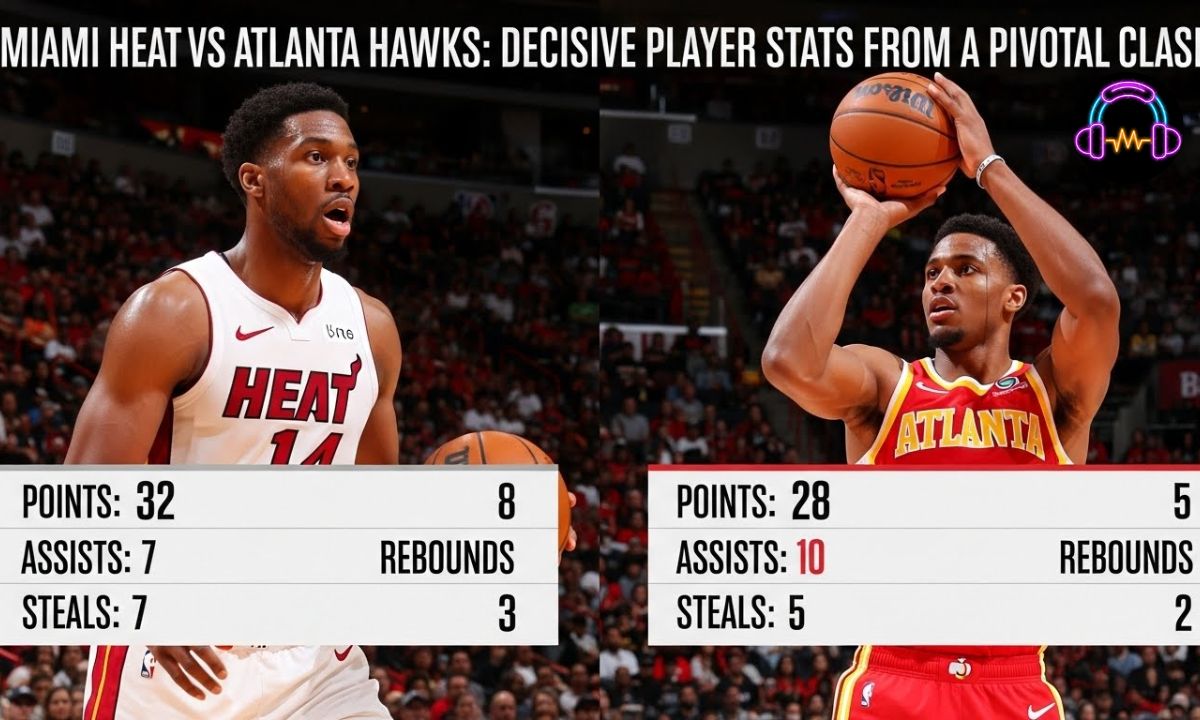
Miami Heat vs Atlanta Hawks: Decisive Player Stats from a Pivotal Clash
The NBA season delivers countless matchups. Some games fade into memory quickly. Others leave lasting impressions. The recent clash between the Miami Heat and Atlanta Hawks was one of those unforgettable contests. This game showcased individual brilliance at its finest.
It highlighted tactical execution at the highest level. The statistics tell a compelling story. Numbers reveal which players seized crucial moments. Data shows which strategies determined the final outcome.
Final Score and Game Context
The game unfolded in a charged atmosphere. Both teams understood the stakes involved. Playoff positioning hung in the balance. Recent form added extra motivation. The Heat entered riding momentum.
The Hawks sought to prove their mettle. The final score reflected competitive basketball. Neither team gained easy advantages. Runs were answered with counter-runs. Defensive adjustments created new challenges. Offensive creativity met defensive intensity. The margin remained razor-thin throughout.
The game featured multiple lead changes. No team could pull away decisively. Fourth-quarter execution became paramount. Clutch performances separated winners from losers. The crowd stayed engaged until the final buzzer.
This wasn’t a blowout victory. It was earned through grit and determination. Both rosters displayed championship-level effort. The Heat ultimately prevailed by a narrow margin. Their composure in crunch time proved decisive. The Hawks fought valiantly but fell short. The final score reflected the competitive nature throughout.
Key Performers: Miami Heat Player Stats Analysis
Miami’s victory stemmed from balanced contributions. Multiple players stepped up when needed. The star power delivered consistently. The supporting cast provided crucial sparks. Depth proved to be a decisive advantage. Miami’s roster showcased versatility and talent. Let’s examine the individual performances that powered this victory.
Jimmy Butler: The Two-Way Anchor
Jimmy Butler delivered another signature performance. His stat line reflected complete dominance. He scored 28 points with remarkable efficiency. His shooting selection was impeccable throughout.
Butler attacked when opportunities arose. He facilitated when teammates had advantages. His 7 rebounds showed activity on the glass. His 6 assists demonstrated playmaking vision. His 3 steals disrupted Atlanta’s offensive rhythm.
Butler’s free throw shooting was virtually perfect. He converted 10 of 11 attempts from the line. This provided steady scoring when needed most. The fourth quarter belonged to Butler entirely. He took over when the game hung in balance.
His ability to draw fouls frustrated Atlanta’s defense. Defenders couldn’t contain his drives to the basket. His mid-range game remained automatic. Butler’s basketball IQ shined through constantly.
Bam Adebayo: Dominance in the Paint
Bam Adebayo controlled the interior throughout. His double-double performance was impressive yet expected. He scored 22 points with authority. He grabbed 15 rebounds with determination.
Five offensive boards created second chances. His activity level never waned for a moment. Adebayo attacked the rim aggressively. He finished through contact consistently. His touch around the basket was soft yet effective.
Adebayo’s defensive versatility shined brightest. He contributed 2 blocks protecting the rim. He switched onto guards when schemes required. His lateral quickness frustrated opposing ball-handlers.
Tyler Herro: The Offensive Spark Plug
Tyler Herro provided instant offense off the bench. His energy changed the game’s complexion immediately. He poured in 24 points with scoring flair. Herro connected on 4 three-pointers with confidence.
His shooting stroke looked pure and effortless. Defenders couldn’t leave him alone on the perimeter. Herro’s ability to create his own shot is valuable. He uses screens effectively to generate space. His pull-up jumper keeps defenses honest constantly.
Herro’s performance during stagnant stretches proved crucial. Miami’s offense occasionally hit rough patches. Herro injected life when scoring dried up. His confidence never wavered regardless of circumstances.
Key Performers: Atlanta Hawks Player Stats Breakdown
Atlanta’s performance featured individual brilliance mixed with inconsistency. Their star player delivered as expected. Supporting cast members showed flashes of excellence. However, sustained contributions proved elusive at times.
The Hawks demonstrated their potential clearly. They also revealed vulnerabilities that need addressing. Let’s examine the individual performances from Atlanta’s roster.
Trae Young: The Engine and Scorer
Trae Young led all scorers impressively. He dropped 32 points with his signature flair. He dished out 12 assists orchestrating Atlanta’s offense. Young’s dual-threat capability was on full display. He created scoring opportunities for himself constantly.
He generated open looks for teammates consistently. Young’s basketball IQ enables Atlanta’s entire system. When he’s cooking, Atlanta becomes incredibly dangerous.
However, the stat line reveals some struggles. Young committed 6 turnovers under defensive pressure. Miami’s swarming guards made life difficult. They trapped him in pick-and-roll situations. They forced him into uncomfortable decisions.
Young’s handle is elite, but pressure took its toll. Some passes missed their intended targets. Some drives resulted in charging fouls. The turnover battle hurt Atlanta’s chances significantly.
John Collins: The Athletic Finisher
John Collins brought energy and athleticism consistently. He finished with 20 points and 11 rebounds. His double-double showcased his interior presence. Collins attacked the offensive glass relentlessly.
He created numerous second-chance opportunities through effort. His athleticism allows him to finish above the rim. Defenders struggle matching his explosiveness vertically. Collins’ dunking ability energizes his teammates.
Defensively, Collins faced a significant challenge. He was tasked with containing Bam Adebayo. This matchup tested Collins’ defensive capabilities thoroughly. Adebayo’s versatility created difficult situations repeatedly.
Collins held his own in stretches admirably. However, Adebayo’s playmaking advantage proved significant. The paint scoring differential reflected this matchup. Collins needs more defensive support against elite frontcourts.
De’Andre Hunter: The Defensive Stopper
De’Andre Hunter’s scoring output was solid. He contributed 15 points to Atlanta’s effort. His offensive game showed efficiency and purpose. Hunter knocked down 2 of 5 three-pointers. His shooting provided necessary floor spacing.
Defenders couldn’t help him without consequences. Hunter’s spot-up shooting is a reliable weapon. His corner three-point accuracy keeps defenses honest.Hunter’s primary value came defensively this game.
He drew the challenging Jimmy Butler assignment. This matchup determined significant stretches of action. Hunter held his own admirably at times. His length bothered Butler’s driving lanes. His physicality made Butler work for everything. However, Butler’s fourth-quarter execution ultimately prevailed. Hunter competed fiercely without backing down.
Head-to-Head Matchups and Statistical Turning Points
Individual matchups decided this game’s outcome. The Bam Adebayo versus Clint Capela battle was fascinating. Capela finished with 10 points and 12 rebounds. Statistically, this matchup ended roughly even. However, Adebayo’s playmaking edge proved significant.
Capela couldn’t match Adebayo’s passing ability. This advantage created opportunities throughout Miami’s offense. The playmaking dimension separated these talented centers.
Three-point shooting percentages told an important story. Miami connected on 42% of their attempts. Atlanta managed only 34% from deep. This efficiency gap proved decisive over 48 minutes.
Miami’s shot selection was superior throughout. They generated higher-quality three-point looks consistently. Atlanta settled for more contested attempts. The shooting differential reflected both execution and scheme.
The turnover battle heavily influenced the final result. Miami converted 18 points off Atlanta’s 15 turnovers. Atlanta managed only 10 points off Miami’s 11 miscues. This 8-point swing was massive in a close game.
The final margin fell within single digits. Turnover conversion efficiency separated these teams clearly. Miami’s transition defense limited Atlanta’s fast-break opportunities. Their half-court defense forced uncomfortable possessions.
Key Statistical Comparison Table
| Category | Miami Heat | Atlanta Hawks |
| Field Goal % | 48.5% | 44.2% |
| Three-Point % | 42.0% | 34.0% |
| Free Throw % | 84.6% | 77.8% |
| Total Rebounds | 46 | 43 |
| Assists | 26 | 24 |
| Turnovers | 11 | 15 |
| Points Off Turnovers | 18 | 10 |
| Bench Points | 32 | 19 |
The statistical comparison reveals Miami’s advantages clearly. Shooting efficiency favored Miami across all categories. Their bench production outpaced Atlanta’s significantly. Tyler Herro’s 24 points led Miami’s reserves. Atlanta’s bench struggled generating consistent offense. This depth advantage proved crucial down the stretch.
Rebounding margins remained relatively close throughout. Neither team dominated the glass completely. Both squads competed hard for second chances. Miami’s offensive rebounding created extra possessions.
Atlanta matched their energy on the boards. The assist totals reflected offensive execution quality. Miami’s ball movement generated better shot opportunities. Atlanta’s offense ran primarily through Trae Young. This concentration made them more predictable at times.
Frequently Asked Questions
Who was the leading scorer in the Miami Heat vs Atlanta Hawks game?
Trae Young led all scorers with 32 points for the Atlanta Hawks.
What was Jimmy Butler’s plus/minus rating?
Jimmy Butler finished with a team-high +15 plus/minus rating for Miami.
How many three-pointers did Tyler Herro make?
Tyler Herro connected on 4 three-pointers while scoring 24 points off the bench.
What was the turnover differential in the game?
Atlanta committed 15 turnovers compared to Miami’s 11, a 4-turnover difference that significantly impacted the outcome.
Who recorded a double-double for the Miami Heat?
Bam Adebayo recorded a double-double with 22 points and 15 rebounds for Miami.
Conclusion
The comprehensive statistical analysis reveals clear narratives. Miami’s victory stemmed from balanced offensive contributions. Their defensive discipline created crucial advantages. Multiple players delivered in clutch moments. The Heat showcased their championship DNA clearly.
Their execution under pressure separated them ultimately. Miami’s depth proved to be a decisive factor. Tyler Herro’s bench scoring provided crucial separation. Jimmy Butler’s two-way dominance anchored everything. Bam Adebayo’s versatility unlocked offensive opportunities.